kikkake original
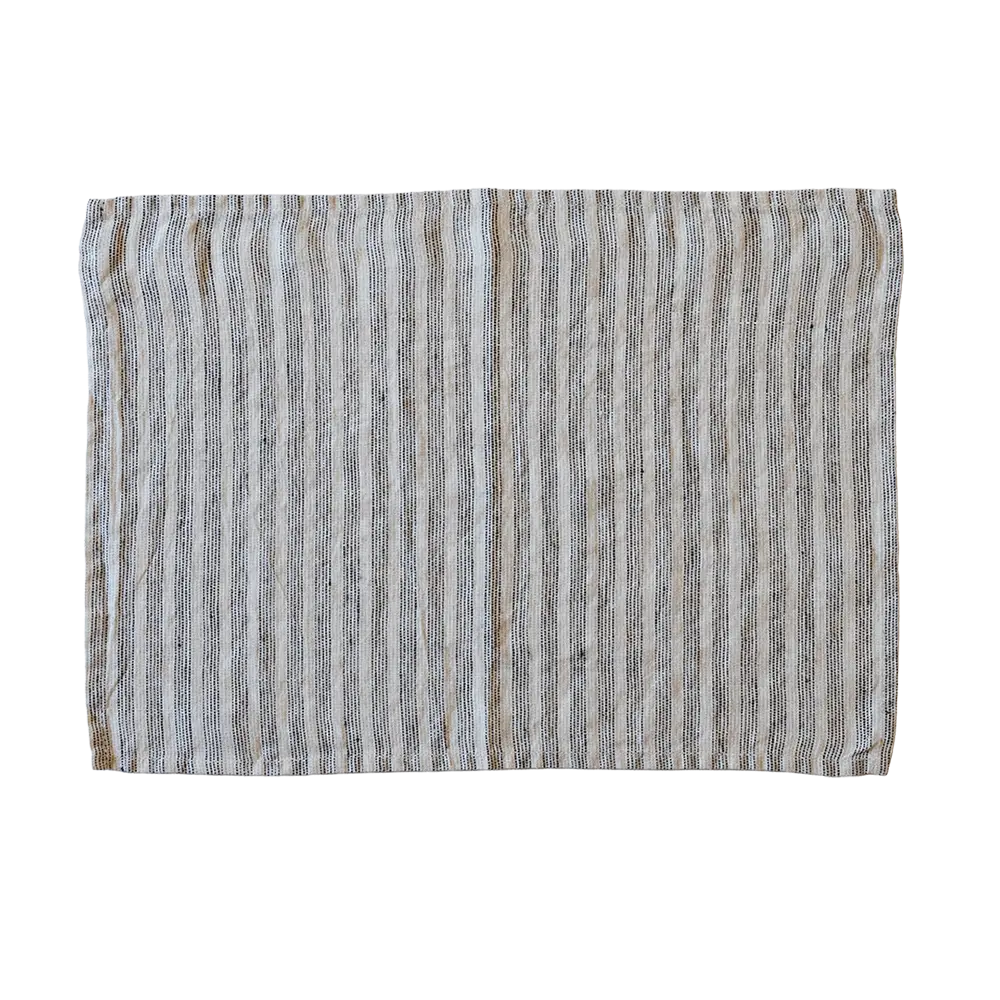
Slightly smaller placemat
79 in stock
Couldn't load pickup availability
Click here for product specifications and features


Slightly smaller than a standard placemat.
Just the right size for everyday use.
Placemats not only prevent tables from getting dirty, but they also reset the mood for a meal, signaling "it's time to eat." Changing them daily can also be a nice change of pace. I really like placemats because they're a pleasant addition to the dining experience. So, if I find a good placemat, I want to buy and use it, but I've always felt that most placemats I encounter are around 45cm wide x 35cm long, which is a bit large.
I thought that if they were a little smaller, they could be used more easily for simple meals and would be easier to use even if the dining table wasn't large. So, I tried various sizes and fabrics to create this original placemat. At 39cm wide x 29cm long, it's a bit smaller, and as expected, it's very easy to use. I hope you'll try it for casual everyday use.


For one-plate dishes like pasta,
simple breakfasts,
or when serving only individual plates for a shared main dish.
Because it's a bit small, the placemat's unused space isn't noticeable even with one-plate meals like pasta, curry, or rice bowls. It's also just right for light breakfasts like bread, fruit, and coffee, or simple meals like rice, miso soup, and a small side dish, suiting both Japanese and Western styles.
It's also the perfect size when serving large dishes in the center of the table and letting each person take a portion onto their individual plate. It's just right for two individual plates, cutlery, and a cup, and even suits slightly more festive occasions.


Made from Lino e Lina linen fabric,
guaranteeing reliable usability.
Available in 4 refreshing and versatile colors.
Also recommended as a gift.
Since the slightly smaller size is its main feature, we eliminated other decorations and aimed for a clean, simple design using high-quality, comfortable fabric. For this, we consulted Lino e Lina, a popular linen brand also featured at kikkake.
From their extensive linen fabrics, we selected four plain and refreshing colors that complement various dishes and tableware: navy, which clearly highlights white plates; melange, which appears blue or gray depending on the light; crisp sax blue, suitable for light scenes like breakfast; and a stripe pattern that adds an accent without being intrusive. You can certainly collect multiple placemats of the same color, but these four colors also combine seamlessly on the same table.
Additionally, like Lino e Lina's kitchen cloths, these are made from pre-washed linen fabric, so they barely shrink after washing and can always be used hygienically. This is another attractive feature. The soft wrinkling characteristic of linen is present, and I think both using them casually as-is or ironing them are wonderful.
Detailed Specifications
Material: 100% linen (pre-washed)
Specifications: Approximately 9.5 cm diameter x 5.8 cm height
Production: Lithuania
Product Characteristics and Points to Note
- Due to the product being pre-washed, there may be a difference of approximately 5% in the stated size due to shrinkage during processing.
- Due to the nature of dyeing natural fibers, there is a possibility of color fading or transfer, especially with navy and melange colors. We recommend washing separately for the first time.
- Leaving the product wet for extended periods may cause color fading or transfer, so please avoid this.
- Machine washing is possible, but please use a detergent without fluorescent brightening agents and avoid chlorine bleach.
- As the product is susceptible to fading from direct sunlight, we recommend air-drying in the shade.
- During the manufacturing process, plant fibers or threads of other colors may get mixed in, or wrinkles may occur in the fabric. We appreciate your understanding of these characteristics.
- Please note that slubs, which are knots, lumps, or streaks of intertwined fibers, may appear on the fabric surface. If noticeable, you can use a sewing needle or other pointed object to push them to the back of the fabric to make them less visible.