
商品の情報、ストアのお知らせをお伝えしていきます。
日報
8.18 Mon. | Indifferent
8.18 Mon. | Indifferent
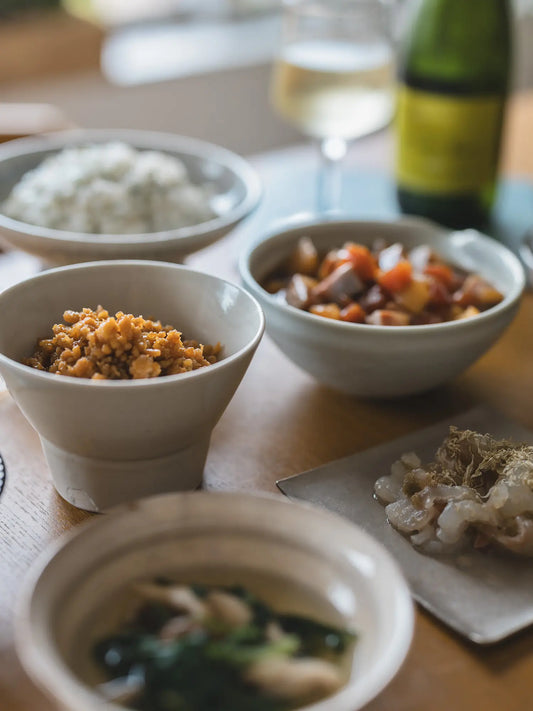
I'm a bit embarrassed to say this, especially since I sell kitchenware and have a cooking YouTube channel, but I'm pretty undiscriminating when it comes to food because I tend to find almost everything delicious. Here are two embarrassing anecdotes:
When I was a student, a friend asked me, "Do you prefer the Tsukimi Burger or the Teritama Burger?" That's when I learned there was more than one hamburger with an egg in it. I used to eat both often but thought they were the same. My friend then said, "The Teritama has teriyaki sauce," but I still didn't understand what they meant.
As an adult, a colleague asked me, "Do you prefer smooth bean paste or chunky bean paste?" That's when I learned there were different types of anko. Anko is delicious no matter what.
Everything is delicious, so anything is fine!
While I'm at it, here's just a simple misunderstanding. I used to think Keio Gijuku was a cram school and Keio Gijuku University was a university.
I'm a bit embarrassed to say this, especially since I sell kitchenware and have a cooking YouTube channel, but I'm pretty undiscriminating when it comes to food because I tend to find almost everything delicious. Here are two embarrassing anecdotes:
When I was a student, a friend asked me, "Do you prefer the Tsukimi Burger or the Teritama Burger?" That's when I learned there was more than one hamburger with an egg in it. I used to eat both often but thought they were the same. My friend then said, "The Teritama has teriyaki sauce," but I still didn't understand what they meant.
As an adult, a colleague asked me, "Do you prefer smooth bean paste or chunky bean paste?" That's when I learned there were different types of anko. Anko is delicious no matter what.
Everything is delicious, so anything is fine!
While I'm at it, here's just a simple misunderstanding. I used to think Keio Gijuku was a cram school and Keio Gijuku University was a university.
8.14 Thu. | Soup
8.14 Thu. | Soup
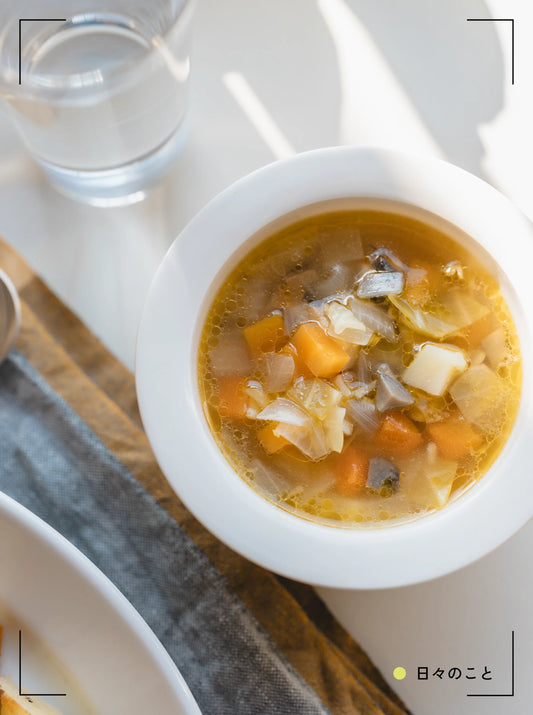
When various ingredients start to accumulate little by little in the fridge, I put them all together and make a soup.
Of course, I consider a minimum balance, but I chop them roughly, sauté them if it seems tastier, add water, taste it, and then decide which direction to go from there.
There are usually three main directions: Japanese style, consommé style, and Chinese style.
The Japanese style then branches into miso or soy sauce directions, which, despite being similar, have quite different vibes.
The consommé style changes depending on whether or not there are tomatoes.
The Chinese style pretty much becomes Chinese no matter what you put in. Oh, but I wonder if making it spicy would change the atmosphere.
Sometimes it becomes a very delicious soup, but I'm just winging it with leftover ingredients and not taking notes, so it's not reproducible. But that's part of the fun.
As far as I remember, when I added a lot of mushrooms, it added depth, and a Japanese-style soup with a lot of grated daikon radish is mild and delicious.
It's really fun when there are accidental discoveries.
When various ingredients start to accumulate little by little in the fridge, I put them all together and make a soup.
Of course, I consider a minimum balance, but I chop them roughly, sauté them if it seems tastier, add water, taste it, and then decide which direction to go from there.
There are usually three main directions: Japanese style, consommé style, and Chinese style.
The Japanese style then branches into miso or soy sauce directions, which, despite being similar, have quite different vibes.
The consommé style changes depending on whether or not there are tomatoes.
The Chinese style pretty much becomes Chinese no matter what you put in. Oh, but I wonder if making it spicy would change the atmosphere.
Sometimes it becomes a very delicious soup, but I'm just winging it with leftover ingredients and not taking notes, so it's not reproducible. But that's part of the fun.
As far as I remember, when I added a lot of mushrooms, it added depth, and a Japanese-style soup with a lot of grated daikon radish is mild and delicious.
It's really fun when there are accidental discoveries.
8.13 Wed. | Organizing
8.13 Wed. | Organizing
When I think about what my hobbies are, the first thing that comes to mind is "tidying up." People often misunderstand, but what I like is tidying up, not cleaning. Cleaning is about removing dirt and dust to make things sparkling clean, but what I like about tidying up is "deciding on a permanent home for things and always putting them back there." So, it's not about wanting things to be clean; it's more like I just really want to put things back in their designated spots right away.
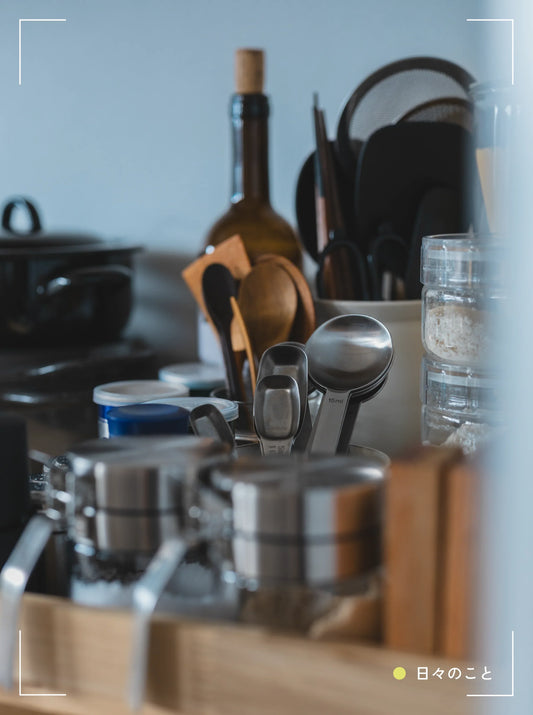
Even when it comes to cooking, I always want to keep dishes, cooking utensils, and seasonings in the same place. So, I put them back as soon as I use them, and take them out again when I need them. I'm constantly cooking with tidying up in mind.
If someone says, "It's good to be tidy, isn't it?" I guess so, but it's not all good. There are times when I think it's a bit of a problem.
That is, even after I've cooked, I find myself wanting to wash the cooking utensils before I eat. I want to tidy up the kitchen before I eat, so I start washing, but depending on the meal, there can be a lot of washing up, and while I'm doing it, the food gets cold. It's totally counterproductive.
I cook to eat, so I should eat the food while it's hot and delicious, but I dislike washing cooking utensils after eating, so I always want to tidy up first.
If I'm alone, it's fine, but when I'm eating with others, I sometimes make them wait, so I know I should be careful not to overdo it depending on the situation... but I just can't stop tidying up!
When I think about what my hobbies are, the first thing that comes to mind is "tidying up." People often misunderstand, but what I like is tidying up, not cleaning. Cleaning is about removing dirt and dust to make things sparkling clean, but what I like about tidying up is "deciding on a permanent home for things and always putting them back there." So, it's not about wanting things to be clean; it's more like I just really want to put things back in their designated spots right away.
Even when it comes to cooking, I always want to keep dishes, cooking utensils, and seasonings in the same place. So, I put them back as soon as I use them, and take them out again when I need them. I'm constantly cooking with tidying up in mind.
If someone says, "It's good to be tidy, isn't it?" I guess so, but it's not all good. There are times when I think it's a bit of a problem.
That is, even after I've cooked, I find myself wanting to wash the cooking utensils before I eat. I want to tidy up the kitchen before I eat, so I start washing, but depending on the meal, there can be a lot of washing up, and while I'm doing it, the food gets cold. It's totally counterproductive.
I cook to eat, so I should eat the food while it's hot and delicious, but I dislike washing cooking utensils after eating, so I always want to tidy up first.
If I'm alone, it's fine, but when I'm eating with others, I sometimes make them wait, so I know I should be careful not to overdo it depending on the situation... but I just can't stop tidying up!
8.12 Tue. | Obon

8.12 Tue. | Obon
Obon is coming soon.
I suddenly wondered if there were any specific Obon dishes, so I
searched, and
it said that shojin ryori (devotional cuisine) is common.
Ah, that certainly feels right.
And it said that somen noodles are often eaten,
which made me think, "Yes, we did eat them a lot."
But even before Obon, we ate somen all the time during summer vacation, so
it felt more like
summer = somen, rather than somen for Obon specifically.
Apparently, somen noodles are likened to the reins of shoryouma (spirit horses) and shoryuushi (spirit cows)
made from cucumbers and eggplants. I see.
I'll try to make something with somen, cucumbers, and eggplants during Obon.
I feel like I can make something easy to eat that's perfect for
the sweltering heat.
Obon, the sound of cicadas, heat haze,
the siren from Koshien flowing from the TV...
Summer is hot and difficult to get through, but
I like its unique melancholy.
Obon is coming soon.
I suddenly wondered if there were any specific Obon dishes, so I
searched, and
it said that shojin ryori (devotional cuisine) is common.
Ah, that certainly feels right.
And it said that somen noodles are often eaten,
which made me think, "Yes, we did eat them a lot."
But even before Obon, we ate somen all the time during summer vacation, so
it felt more like
summer = somen, rather than somen for Obon specifically.
Apparently, somen noodles are likened to the reins of shoryouma (spirit horses) and shoryuushi (spirit cows)
made from cucumbers and eggplants. I see.
I'll try to make something with somen, cucumbers, and eggplants during Obon.
I feel like I can make something easy to eat that's perfect for
the sweltering heat.
Obon, the sound of cicadas, heat haze,
the siren from Koshien flowing from the TV...
Summer is hot and difficult to get through, but
I like its unique melancholy.
8.11 Mon. | Motivation Switch
8.11 Mon. | Motivation Switch
I've never been able to summon motivation just by wanting to.
I rarely felt motivated to study before exams, and if there were a championship for tidying your desk before an exam, I think I would have been good enough to compete at the prefectural level.
It's strange to me now why I would feel motivated to tidy up when I wasn't motivated for the task I was supposed to be doing, but even then, I still couldn't get motivated to study.
Regarding the common saying, "Motivation doesn't come until you start doing it," I used to think, "Is that really true?" but now I'm starting to understand it a bit.
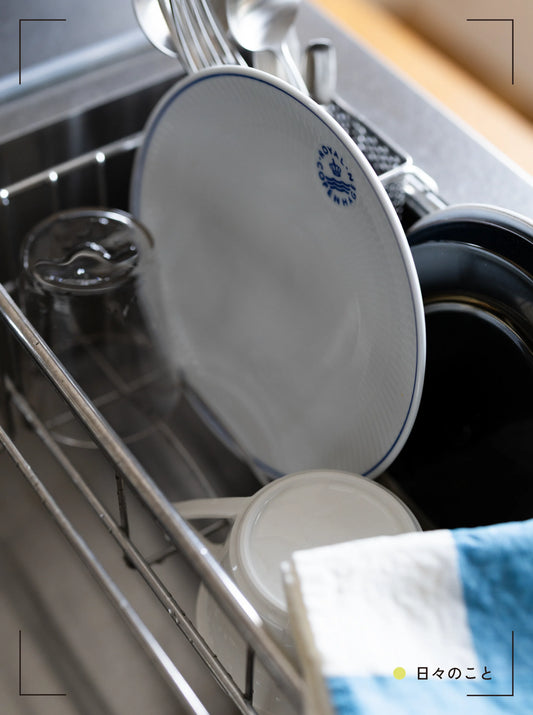
I have a routine to forcefully activate my motivation switch every morning. It's "cleaning up last night's dishes."
There's no particular reason for it, but for the past few years, I've decided to "clean up last night's dishes." Around the time I vaguely started to understand that if you don't start something, nothing will begin, I thought about what I should do, and the one thing I always had to do in the morning was clean up last night's dishes.
After getting out of bed in the morning, to resist the super-huge gravitational pull emanating from the living room sofa, I just do "clean up last night's dishes" without thinking. Then, naturally, I can smoothly continue by making coffee, taking out the trash, making and eating breakfast, and getting dressed.
Since then, I feel like I've become a little better at just starting something without thinking when I lack motivation.
Hey, Mr. Motivation Switch, could you please turn on a bit more easily?!
I've never been able to summon motivation just by wanting to.
I rarely felt motivated to study before exams, and if there were a championship for tidying your desk before an exam, I think I would have been good enough to compete at the prefectural level.
It's strange to me now why I would feel motivated to tidy up when I wasn't motivated for the task I was supposed to be doing, but even then, I still couldn't get motivated to study.
Regarding the common saying, "Motivation doesn't come until you start doing it," I used to think, "Is that really true?" but now I'm starting to understand it a bit.
I have a routine to forcefully activate my motivation switch every morning. It's "cleaning up last night's dishes."
There's no particular reason for it, but for the past few years, I've decided to "clean up last night's dishes." Around the time I vaguely started to understand that if you don't start something, nothing will begin, I thought about what I should do, and the one thing I always had to do in the morning was clean up last night's dishes.
After getting out of bed in the morning, to resist the super-huge gravitational pull emanating from the living room sofa, I just do "clean up last night's dishes" without thinking. Then, naturally, I can smoothly continue by making coffee, taking out the trash, making and eating breakfast, and getting dressed.
Since then, I feel like I've become a little better at just starting something without thinking when I lack motivation.
Hey, Mr. Motivation Switch, could you please turn on a bit more easily?!
8.8 Fri. | Fun Cooking
8.8 Fri. | Fun Cooking
A story about when I went to a tempura restaurant.
It was so long ago that I can't remember when it happened, but an old colleague from my previous job once took me to a tempura restaurant.
It was a small but very clean and proper tempura restaurant. I think it was for lunch because I had a tempura bowl (tendon). I remember being nervous because I had never been to a tempura restaurant before.
We were seated at the counter, and it was impressive to watch the chef skillfully fry tempura right in front of us. What particularly stood out was the tool used to pour the tendon sauce over the rice – it looked like a ladle with three holes at the tip, from which the sauce would flow.
Of course, the tendon I ate then was incredibly delicious, but more than that, I found the experience "enjoyable." There were so many tempura pieces on top of the rice, making it look splendid and fun. Deciding which one to eat first was enjoyable, and I remember thinking it was strange that "enjoyable" was the first word that came to mind, even before "delicious."
While I certainly want to make delicious food, I also aim for cooking to be enjoyable.
Seeing how young I was then, the proprietress said, "Let me know if you want more rice," and I think I did have a second helping.
The delicious and enjoyable tendon was surprisingly expensive, and I was impressed that my senior colleague treated me.
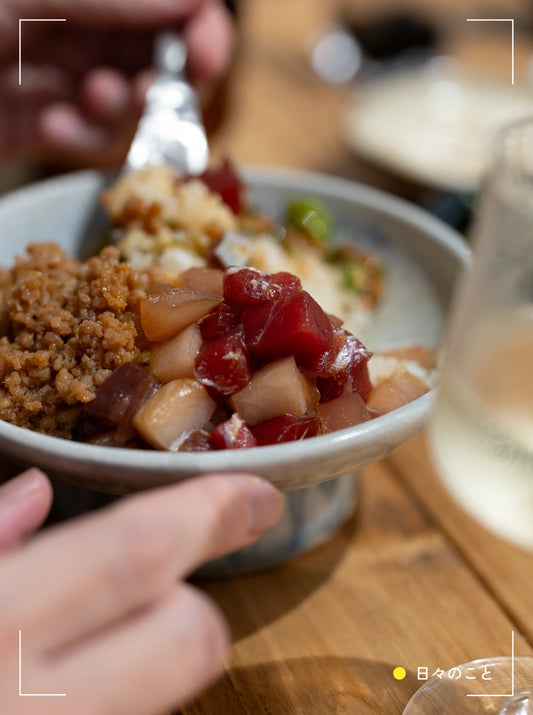
While I was making a lavish donburi for a YouTube test, I felt a sense of enjoyment and suddenly remembered that tendon experience.
A story about when I went to a tempura restaurant.
It was so long ago that I can't remember when it happened, but an old colleague from my previous job once took me to a tempura restaurant.
It was a small but very clean and proper tempura restaurant. I think it was for lunch because I had a tempura bowl (tendon). I remember being nervous because I had never been to a tempura restaurant before.
We were seated at the counter, and it was impressive to watch the chef skillfully fry tempura right in front of us. What particularly stood out was the tool used to pour the tendon sauce over the rice – it looked like a ladle with three holes at the tip, from which the sauce would flow.
Of course, the tendon I ate then was incredibly delicious, but more than that, I found the experience "enjoyable." There were so many tempura pieces on top of the rice, making it look splendid and fun. Deciding which one to eat first was enjoyable, and I remember thinking it was strange that "enjoyable" was the first word that came to mind, even before "delicious."
While I certainly want to make delicious food, I also aim for cooking to be enjoyable.
Seeing how young I was then, the proprietress said, "Let me know if you want more rice," and I think I did have a second helping.
The delicious and enjoyable tendon was surprisingly expensive, and I was impressed that my senior colleague treated me.
While I was making a lavish donburi for a YouTube test, I felt a sense of enjoyment and suddenly remembered that tendon experience.